Large regional differences in the number of young recipients of supplementary and preventive social assistance
The number of households receiving supplementary social assistance increased in 11 wellbeing services counties and decreased in 12. The number of households receiving preventive social assistance increased in eight counties and decreased in 14.
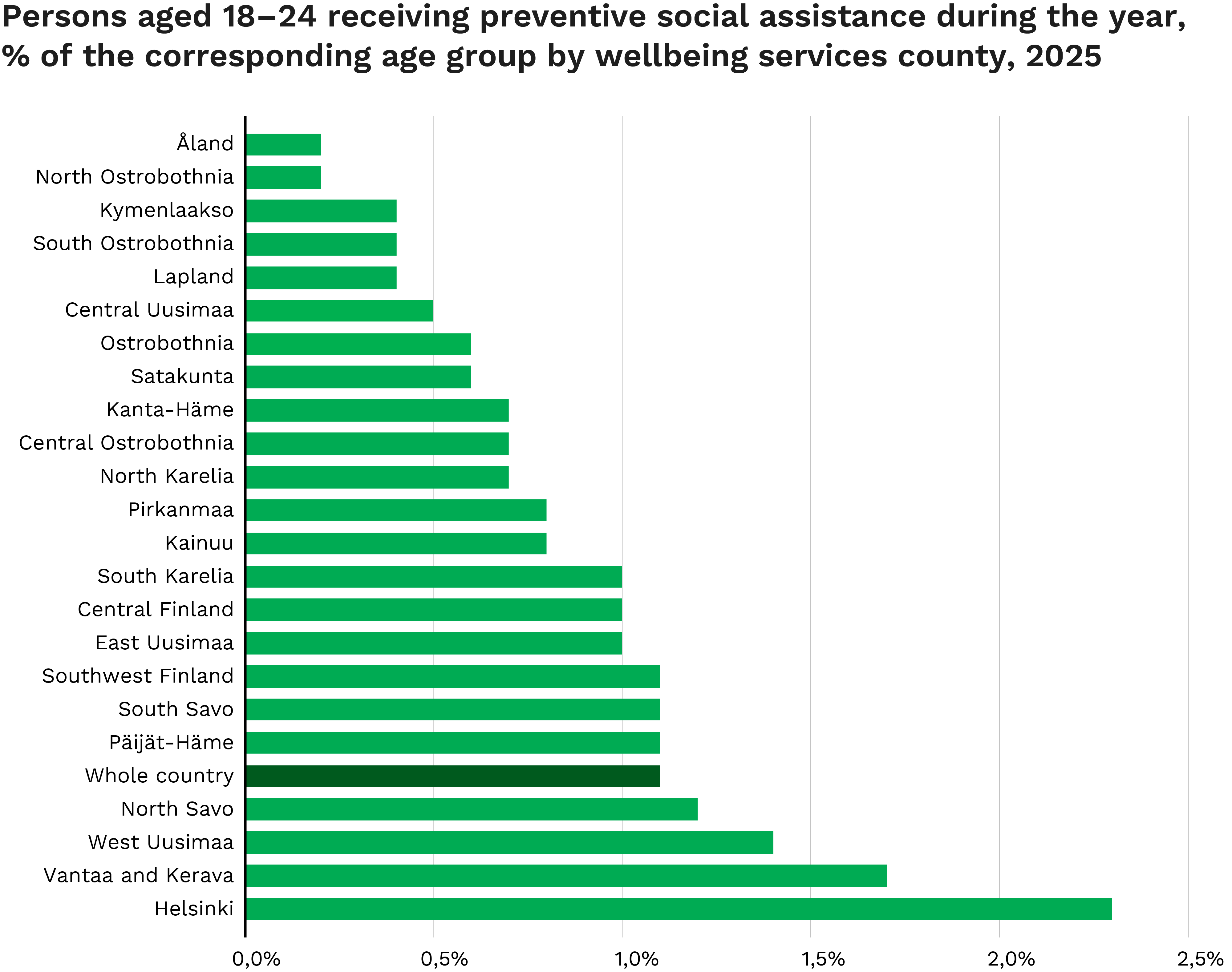
“Regional differences in supplementary and preventive social assistance are substantial and particularly pronounced among 18–24 year olds. The share of young people receiving preventive social assistance ranges from approximately 0.2% to 2.3% of the age group,” says Samuli Pietilä, Senior Specialist at THL.
“In practice, this means that in some areas the proportion of recipients of preventive social assistance is more than tenfold compared with areas where there are few such clients,” Pietilä continues.
Supplementary and preventive social assistance are granted on the basis of individual discretion for specific expenses and situations not covered by basic social assistance.
Applications are submitted to one’s own wellbeing services county. As a rule, applicants must first have applied for basic social assistance from Kela.
The social assistance register now covers all social assistance – basic assistance data are not comparable with previous years
Previously, THL’s social assistance register included only data on basic social assistance jointly financed by the state and municipalities. Basic social assistance fully funded by the state was not included.
The fully state-funded basic social assistance scheme was discontinued on 1 April 2025. From then on, all basic social assistance is financed equally by the state and municipalities. As a result, starting from 2025, clients who previously received state-funded assistance and the related expenditure are included in THL’s register.
The state-funded scheme mainly covered social assistance for refugees, return migrants, asylum seekers, and persons granted temporary protection.
“This change complicates the interpretation of this year’s figures, as the 2025 data are not comparable with earlier years,” Pietilä notes.
“In practice, a new client group has been added to the register, consisting largely of Ukrainians who have fled Russia’s war of aggression. They may become eligible for social assistance after one year of residence. They are typically not granted unemployment benefits, which means that the amount of basic social assistance paid to them is on average higher, and the need for support may also be more long-term than in other client groups,” Pietilä adds.
Seven per cent of the population received social assistance in 2025
In 2025, social assistance was granted to 271,000 households and 398,000 individuals, corresponding to 7% of the population.
A total of 256,000 households received basic social assistance, 53,000 supplementary social assistance, and 32,000 preventive social assistance. The number of households receiving supplementary assistance increased by 1%, while the number receiving preventive assistance decreased by 3%.
Social assistance expenditure nearly EUR 1.1 billion in 2025
Expenditure on basic social assistance increased by a total of EUR 245 million in 2025.
Total social assistance expenditure amounted to EUR 1,051 million. Of this, EUR 1,004 million was basic social assistance, EUR 27 million supplementary social assistance, and EUR 20 million preventive social assistance.
18–24-year-olds receiving preventive social assistance during the year, % of the corresponding age group by wellbeing services county, 2025
Further information
Samuli Pietilä
Senior Specialist
Tel. +358 29 524 7162
[email protected]
Paula Saikkonen
Research Manager
Tel. +358 29 524 8133
[email protected]