Organisation
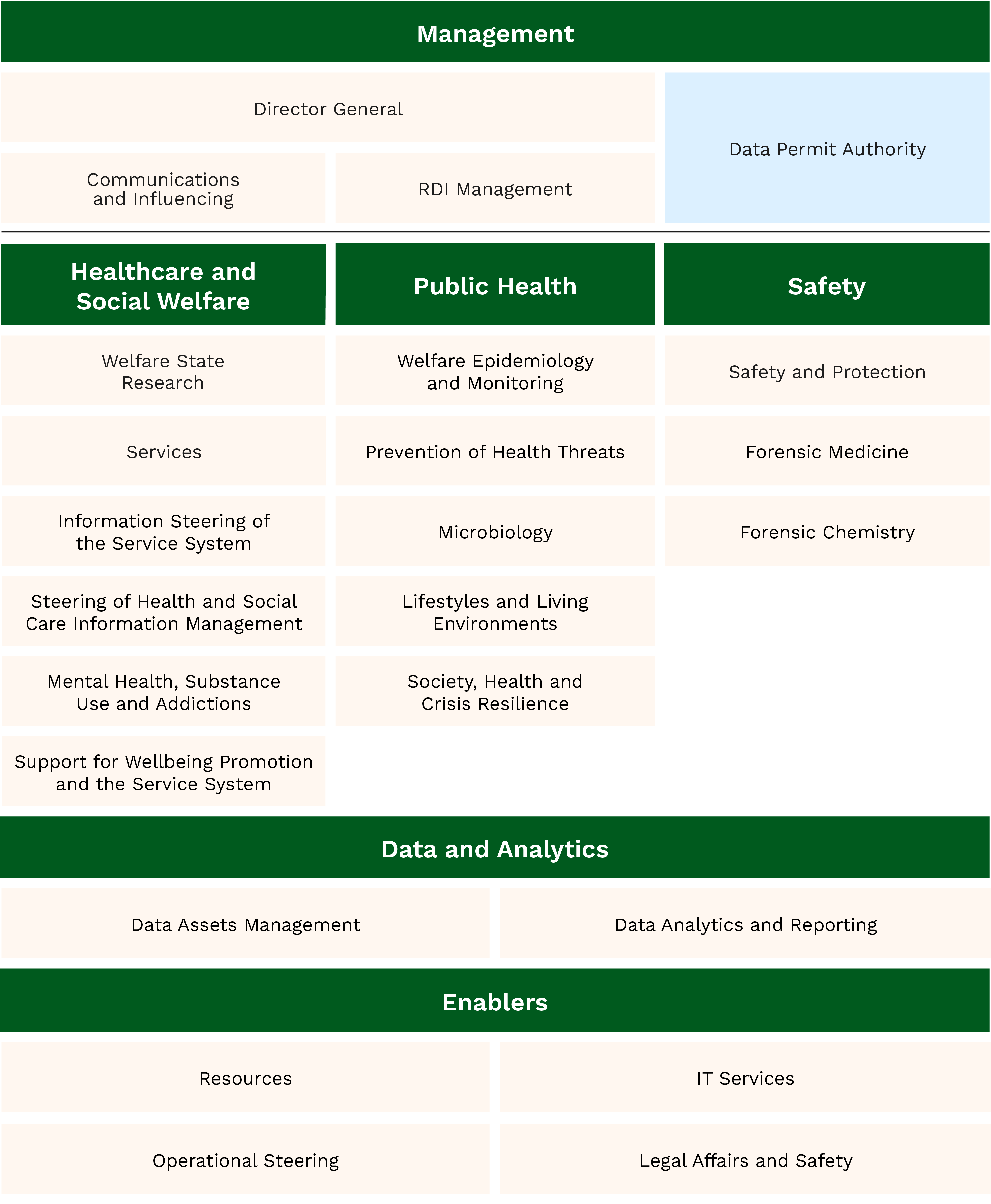
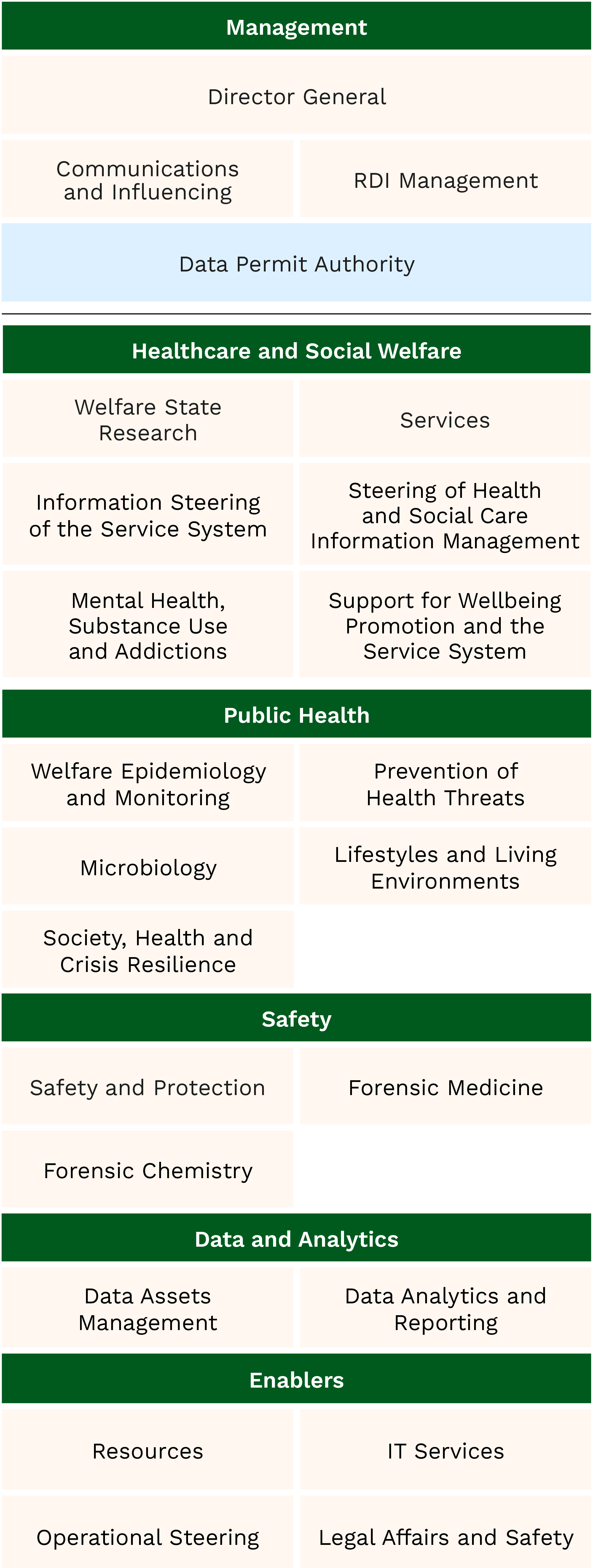
THL's management team is in charge of the overall management of the institution. In addition to the Director General, the management team includes the RDI Director, the Communications Director and all the directors of departments. THL has five departments: Healthcare and Social Welfare, Public Health, Safety, Data and Analytics and Enablers. The departments are further divided into units and teams. In addition, RDI Management Team and a Communications and Influencing Unit operate directly under the management team. The Data Permit Authority operates in conjunction with THL.
Departments
Management
The Director General leads the institute together with the management team. Communications and Influencing, Research, Development and Innovation (RDI) Management, and the Finnish Health and Social Data Permit Authority operate directly under the Director General.
Healthcare and Social Welfare
Healthcare and Social Welfare Department
- Monitors, evaluates, and researches the functioning, costs, quality, and effectiveness of the healthcare and social welfare service system and social security.
- Supports the development and integration of the healthcare and social welfare service system and social security, taking into account special groups and services at different life stages.
- Supports the Government in steering the service system, with particular responsibility for information steering.
- Steers and develops data management, documentation, and the processing of client data in healthcare and social welfare.
- Provides data products to support decision-making, steering, monitoring, and development of healthcare and social welfare services.
- Researches and anticipates the need for healthcare and social welfare services, develops the financing model for wellbeing services counties, and is responsible for calculating need coefficients that form the basis of funding.
- Supports wellbeing services counties and municipalities in promoting health and wellbeing.
- Monitors and researches the population’s mental health, substance use, gambling-related harm and addictions, as well as their risk and protective factors.
Department's units:
- Welfare State Research
- Services
- Information Steering of the Service System
- Steering of Health and Social Care Information Management
- Mental Health, Substance Use and Addictions
- Support for Wellbeing Promotion and the Service System
Public Health
The Department of Public Health
- Monitors, researches and models communicable and non-communicable diseases in the population and across different population groups.
- Prepares for and responds to health threats and evaluates the effectiveness of interventions.
- Acts as an expert and reference laboratory in microbiology and persistent chemicals in food.
- Promotes planetary health, wellbeing and social sustainability.
- Conducts intervention and behavioural research related to public health.
Department's units:
- Welfare Epidemiology and Monitoring
- Prevention of Health Threats
- Microbiology
- Lifestyles and Living Environments
- Society, Health and Crisis Resilience
Safety
Safety Department
- Coordinates work against violence and child protection at the national level and supports the development and steering of services.
- Strengthens expertise and the knowledge base related to violence and child protection through research and project activities.
- Acts as a nationally centralised expert centre for forensic functions (forensic medicine and forensic chemistry).
- Performance-manages state social and health authorities (state child protection institutions, state psychiatric hospitals, prison healthcare).
Department's units:
Data and Analytics
Data and Analytics Department
- Is responsible for the institute’s knowledge base and ensures that the data used in decision-making, steering, monitoring, and development is reliable, comparable, and fit for purpose.
- Manages the lifecycle and quality of data and maintains and develops shared definitions and operating models.
- Produces interoperable, comparable, and usable data for further processing, as well as agreed analytics and reporting to support departmental work.
- Promotes the use of data that is findable, accessible, interoperable, and reusable.
Department's units:
Enablers
The Enablers department creates the conditions for leadership, organisational operations and achieving objectives.
The department
- Supports THL’s development and is responsible for IT and data production services.
- Provides THL’s support services (including HR, finance, facilities, safety, legal services, registry and operational steering).
- Is responsible for special services: THL’s pharmaceutical wholesale operations and forensic psychiatry.
Department's units: