
Data quality
THL’s statistics are mainly based on register data that describes how the population uses services and on THL’s extensive population studies, which consist of surveys as well as health examinations measurements.
High-quality data requires wide-ranging collaboration between THL, data providers, health and social services professionals, patient and client information system providers, and the users of the data. The quality of the data is ensured at all stages of its life cycle, from the definitions of the collected data to metadata descriptions and from the processing of the data to its archiving.
Statistics on the data collected by THL are published in various electronic reporting services and in THL’s statistical series.
The most up-to-date data are unchecked, whereas the data published in statistical reports have been reviewed
THL provides data for the needs of different users. The way of collecting the data, the source and the data collection methods determine the type of use that data is suitable for.
Reviewed data are typically presented in statistical reports published annually. The quality reports of statistical reports assess the coverage and quality of the data and describe, for example, data gaps.
Statistical reports provide interpretation to support the figures and often describe long-term developments.
For example, in addition to statistical reports, the health care register data maintained by THL is also published in the form of regularly updated information, with updates occurring daily and monthly. The data in these up-to-date reports have not been reviewed and may change after publication. Preliminary data that may still be specified after their publication are also published on other statistics to ensure that the data can be used in a timely manner.
THL, the data providers and health and social services professionals are jointly responsible for the quality of healthcare and social welfare data
High-quality healthcare and social welfare data are created as a result of cooperation between THL, other authorities, patient and client information system providers and health and social services professionals at all stages of the data life cycle.
The data life cycle refers to all the stages that are needed to make the data ready to be used for a specific purpose.
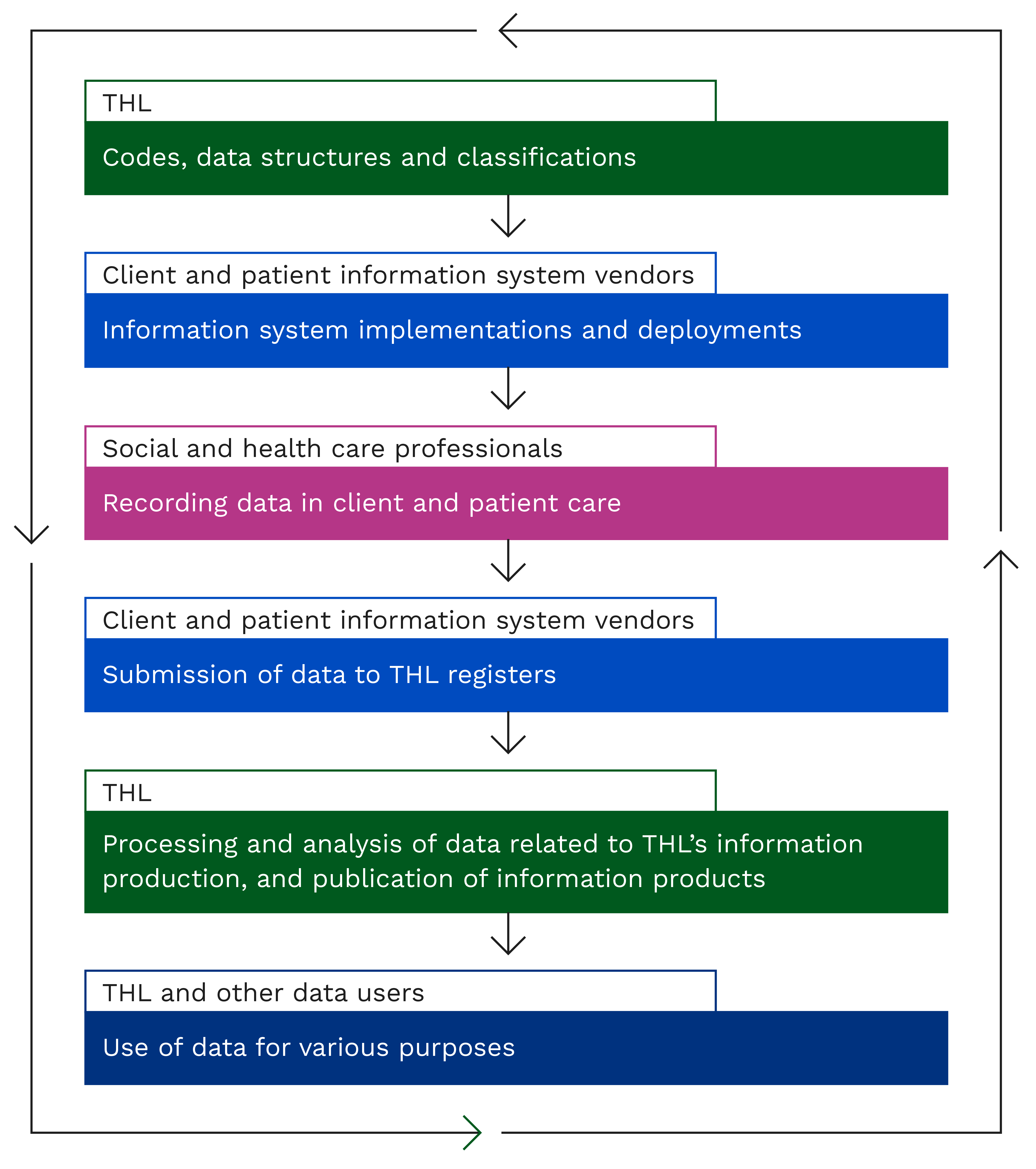
Harmonised code sets, data structures and classifications determine, already at an early stage of the data life cycle, what types of data and quality can be obtained from the systems.
When the data are recorded, health and social services professionals record details of the patient’s or client’s care event in the client and patient information system in accordance with guides and instructions.
The organizations providing the data are responsible to THL for the accuracy of the information they submit. The data providers include e.g. wellbeing services counties, municipalities, and private organizations offering social and health care services.
Patient and client information system providers often handle the submission of data to THL’s registers. They must also comply with the instructions issued by THL for submitting data.
THL regularly produces different types of quality feedback on the data provided to data suppliers and service providers.
THL’s statutory duties supporting the quality of data
The Finnish Institute for Health and Welfare
- is responsible for the guidelines for documentation in social welfare and health care
- maintains and harmonises data structures and code sets
- is responsible for shared concepts and vocabulary in healthcare and social welfare
- acts as one of Finland’s statistical authorities. All THL statistics meet the quality criteria of the Official Statistics of Finland (OSF).
A quality report is published on all THL statistics
The quality report assesses the reliability and suitability of the statistics for different purposes on a statistics-specific basis according to the quality report recommendation of the Official Statistics of Finland (OSF).
A quality report is also produced on statistics that are not included in the OSF series.
The quality and principles of statistics ensure data usability
Because THL is a statistical authority, all its statistics meet the quality criteria of the Official Statistics of Finland (OSF), which are based on the quality criteria of the European Statistical System. The criteria support the usability of the statistics for the information needs of society.
The principles underlying the development and distribution of statistics are
- professional independence
- impartiality
- objectivity
- reliability
- data protection and data security
- cost-efficiency.
The principles of national statistical activities are based on the following international and national principles and practices:
- UN Statistical Commission's Fundamental Principles of Official Statistics
- European Statistical System (ESS)
- European Statistics Code of Practice
- Recommendations of the Advisory Board of Official Statistics of Finland (OSF)
- Development strategy for the Finnish statistical ecosystem