Taking into care of children under 3 has increased – otherwise no major changes in child welfare statistics
The number of children aged 0–2 who were taken into care increased by 9% in 2025. A total of 292 children were taken into care in 2025. The number of children under 3 receiving support in open care increased by 10%.
Urgent placements in this age group increased only slightly (+3%), as did the number of children aged 0–2 who were subject to child welfare notifications (+2%).
“It is important that families with children receive support when they need it. For young children, an increase was visible across all areas of child welfare. This is noteworthy and may indicate increased pressure on families with children, or that authorities are intervening more decisively than before,” says Johanna Hedman, development manager at THL.
Key child welfare indicators remained largely unchanged at the national level in 2025.
Regional differences are substantial
There are considerable differences between wellbeing services counties. In South Karelia, Eastern Uusimaa and Ostrobothnia, the numbers of clients, urgent placements and children taken into care are relatively low.
“Differences between regions may reflect variations in how services are organised, but also differences in population wellbeing and socio-economic factors,” says Hedman.
Child welfare notifications and the number of open care clients can be examined in more detail by region in THL’s online service.
Child welfare open care is most common among teenagers
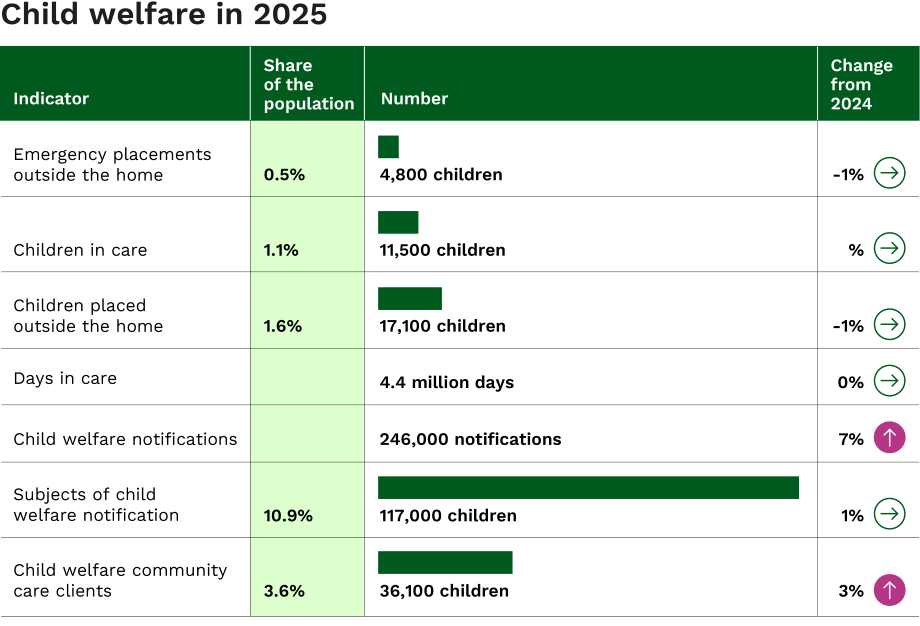
Child welfare open care was most common among teenagers. In 2025, 3.6% of all children were clients in open care, with the highest share among 16–17-year-olds (4.8%).
Child welfare notifications continued to increase in this age group. During the year, a notification was made for one in seven (14.7%) 16–17-year-olds.
“The prominence of adolescents in the statistics may indicate that accumulated support needs among children and families are identified too late, but also that challenges related to mental health and behaviour that become more pronounced during adolescence cannot be adequately addressed within other services,” notes Taina Laajasalo, research professor at THL.
No changes in the number of placements
A total of 17,100 children were placed in out-of-home care (1.6% of all children), which is at the same level as in previous years.
During the year, 11,500 children were in care (1.1%), and 4,800 children were subject to urgent placement (0.5%).
“The stability in the number of placements does not in itself indicate whether the situation has worsened or improved. It may reflect stabilisation or that decisions to place children outside the home are being assessed more critically than before,” Hedman notes.
Notifications are increasingly concentrated on the same children
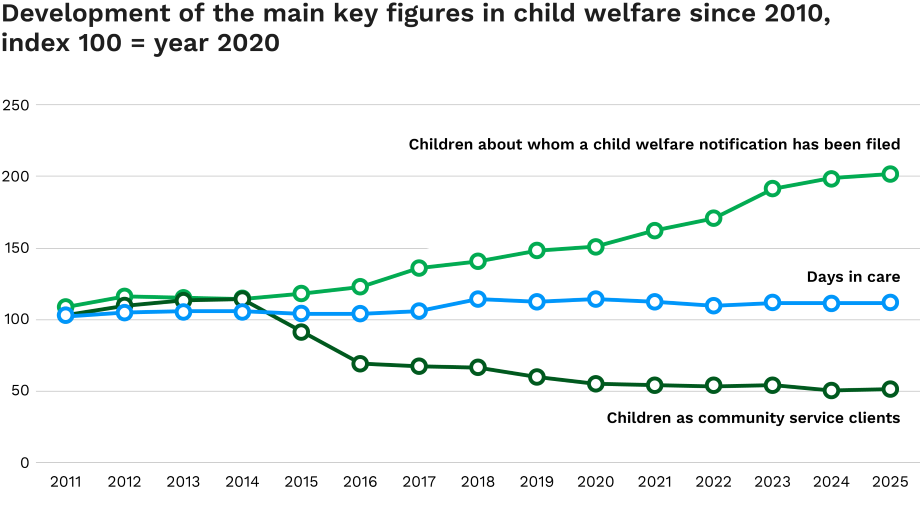
In 2025, a child welfare notification was made for 117,000 children, corresponding to 10.9% of all children. The total number of notifications increased to 246,000 (+7%), while the number of children concerned increased only slightly (+1%).
“When the number of notifications increases but the number of children does not, it indicates that notifications are accumulating for the same children. More comprehensive data to be introduced in the autumn will help to better understand this phenomenon,” says Martta Forsell, chief specialist at THL.
Support for child welfare clients is increasingly proposed to be provided through family services
The Ministry of Social Affairs and Health proposes that support for children and families should increasingly be provided through services under the Social Welfare Act. Proposed amendments to the Social Welfare Act and the Child Welfare Act are currently under consultation.
According to THL estimates, approximately 150,000 children were covered by family services, corresponding to 15% of all children.
“This year, we were able for the first time to analyse, based on data from some wellbeing services counties, what social services child welfare clients have received. In the future, we will be able to analyse more precisely what kind of support children, young people and their families receive. The data base of social welfare will become more detailed with the introduction of the Kanta services,” says Forsell.
“In the future, more detailed information should also be obtained, for example on child welfare institutions, and therefore THL hopes that the next government will invest in strengthening the child welfare data base in this respect as well,” adds Johanna Hedman.
Further information
Johanna Hedman
team manager, development manager
THL
tel. 029 524 7194
Taina Laajasalo
research professor
THL
tel. 029 524 7777
Martta Forsell
chief specialist
THL
tel. 029 524 7974
Email addresses: firstname.lastname@thl.fi