
Experiences of Social Inclusion Scale (ESIS)
The Experiences of Social Inclusion Scale (ESIS) consists of 10 statements measuring the experience of social inclusion, such as the experience of meaningfulness, beliefs about personal agency, opportunities to influence, and quality of social interaction.
You can use the scale in population studies, surveys, and impact assessments.
- If you want to use ESIS, please read the instructions carefully.
- The scale must be used in its official, validated form. Modifying or adapting the statements is not permitted.
- The statements can be used in group discussions at a general level as a basis for conversation and to stimulate reflection. However, do not complete the scale or discuss how each person would respond to the statements in the same context – unless someone chooses to share their responses voluntarily. The group discussion must not serve as a hidden form of assessment (see next section). Participation in the discussion must be voluntary.
- At this time, we do not recommend using the ESIS for individual client assessments as part of personalized client guidance, as the approach has not yet been sufficiently researched. If you are planning a study on the use of ESIS in client guidance, please contact us.
For further assistance or specific language versions, please contact one of the researchers listed at the end of the website. The ESIS is available in 20 language versions.
The ESIS has been scientifically validated with excellent results. The scale was developed by the Finnish Institute for Health and Welfare (THL) with the co-funding by the European Union.
The ESIS has been included in various population studies conducted by the Finnish Institute for Health and Welfare, such as FinSote 2019, Healthy Finland (2022), and the School Health Promotion study (since 2019), as well as in studies by other organisations, including the Capital Region Well-Being Survey, the City of Vantaa Inclusion Questionnaire, Päijät-Häme Wellbeing County, and universities.
To date, about 250 organisations and projects have used the ESIS for impact assessment.
On this page
General description of the Experiences of Social Inclusion Scale
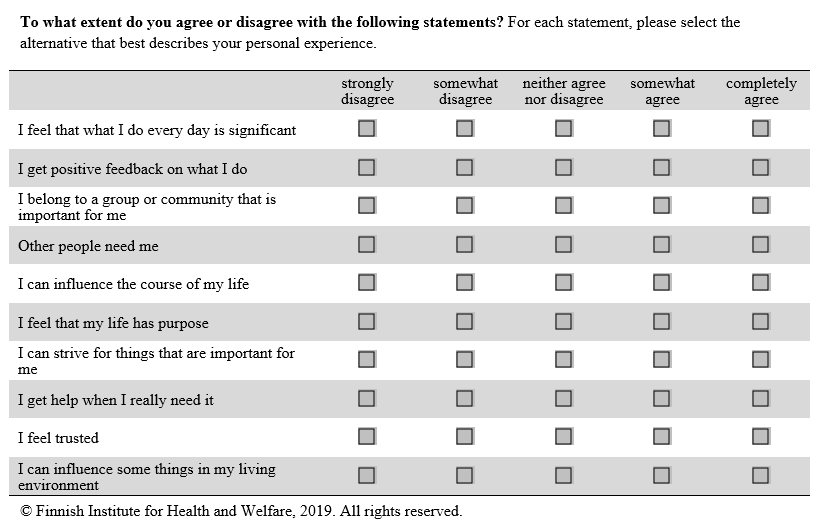
The lead question of the Experiences of Social Inclusion Scale is:
”What is your opinion of the following statements? Please mark for each statement the alternative that best describes your experience”.
The statements on the Experiences of Social Inclusion Scale are:
- I feel that what I do every day is significant
- I get positive feedback on what I do
- I belong to a group or community that is important for me
- Other people need me
- I can influence the course of my life
- I feel that my life has a purpose
- I can strive for things that are important for me
- I get help when I really need it
- I feel trusted
- I can influence some things in my living environment.
The response options are 1) fully disagree, 2) somewhat disagree, 3) neither agree nor disagree, 4) somewhat agree and 5) strongly agree. For each statement a score of 1 to 5 points is given in the order presented above (fully disagree = 1 point, strongly agree = 5 points).
The Experiences of Social Inclusion Scale is calculated by summing the scores for the statements and the sum is converted to a scale of 0 to 100. Higher scores refer to a stronger experience of social inclusion. The experience of social inclusion can be reported as a continuous variable or a cut-off point can be used. A score below 50 has been defined as the threshold for a very weak experience of social inclusion. This cut-off point is used, for example, in the Sotkanet statistical service.
If you use the Experiences of Social Inclusion Scale, it is important to use it precisely in this format and follow the detailed instructions provided on this page.
The scale can be used to measure individuals’ experiences of social inclusion. If measured more than once, the change in the respondents’ experiences can be examined on individual or group level.
Collecting data from larger amounts of respondents allows examining group differences in the experience of social inclusion, for example differences in mean scores by gender, age group, employment status or other background variables.
The scale can be widely used in various operational environments, as it is not tied to any specific service system or cultural context.
The ESIS has been successfully used in the School Health Promotion Survey among students at the 8th grade of the Finnish comprehensive school and older (14+ years old). The applicability for children below this age has not been thoroughly evaluated so far.
The ESIS has been developed within the Finnish Institute for Health and Welfare’s (THL) Project to co-ordinate the promotion of social inclusion (Sokra) and Coordination for Equal Inclusion, with co-funding from the European Union.
The Experiences of Social Inclusion Scale is Scientifically Validated: The Scale Performs Very Well
The Finnish-language version of the Experiences of Social Inclusion Scale has been scientifically validated using multiple methods. In the validation study conducted by the Finnish Institute for Health and Welfare (THL) (Leemann et al., 2021), the scientific validity of the scale was examined systematically and comprehensively. All examined criteria for scientific validation demonstrate that the scale performs well and accurately measures the intended construct – experiences of social inclusion.
The statements form a coherent whole, meaning that the inclusion of each item in the scale is justified.
Correlations between the scale and measures of perceived health, loneliness, and quality of life found in the validation study further support the notion that the experience of social inclusion is a key component of overall well-being. However, the analyses also show that the Experiences of Social Inclusion Scale does not measure these related constructs directly, but rather its own distinct domain: the experience of social inclusion.
Development and Psychometric Evaluation of the Experiences of Social Inclusion Scale.
Leemann, Lars, Martelin, Tuija, Koskinen, Seppo, Härkänen, Tommi & Isola, Anna-Maria (2022). Journal of Human Development and Capabilities, 23:3, 400–424
Background of the statements of the Experiences of Social Inclusion Scale (ESIS)
The statements of the Experiences of Social Inclusion Scale (ESIS) have been developed based on previous research and academic literature. They have been tested and further refined using feedback gathered from group interviews and an open online test.
The statements are based on a specific theoretical framework for social inclusion, which incorporates theories from different scientific disciplines and is based on findings from qualitative research on the consequences of prolonged poverty. The theoretical framework is briefly described in English in the validation study (above).
Mitä osallisuus on? Osallisuuden viitekehystä rakentamassa.
Isola, Anna-Maria, Kaartinen, Heidi, Leemann, Lars, Lääperi, Raija, Schneider, Taina, Valtari, Salla, & Keto-Tokoi, Anna (2017). Discussion Paper 2017/33. Helsinki: Finnish Institute for Health and Welfare.
Instructions related to using the Experiences of Social Inclusion Scale (ESIS), scoring and calculating sum score
The Experiences of Social Inclusion Scale (ESIS) is presented in figure 1. The scale must be used verbatim in the exact form presented here. The ESIS main question, guiding phrase, response options, statements or their order may not be changed, altered or omitted in any way.
The Experiences of Social Inclusion Scale has been validated in this exact form. Results obtained using different question sets cannot be directly compared.
The Experiences of Social Inclusion Scale can be implemented using a paper questionnaire or electronically. Whenever possible, respondents should answer on their own. As a face to face interview the scale has not been validated and should therefore be avoided.
In all cases, the use of the ESIS must comply with the general principles of research ethics (e.g. informed consent, voluntariness and anonymity) and all data protection guidelines.
The use of the ESIS is free of charge.
Scoring of the Experiences of Social Inclusion Scale
| Answer Option | Points |
|---|---|
| strongly disagree | 1 point |
| somewhat disagree | 2 points |
| neither agree nor disagree | 3 points |
| somewhat agree | 4 points |
| completely agree | 5 points |
Calculating the sum score for the Experiences of Social Inclusion Scale (ESIS)
The sum score for ESIS is calculated from the scores of the single statements, resulting in a raw sum score between 10 and 50. This score is then converted to a scale of 0 to 100. The final sum score is calculated according to the following formula:
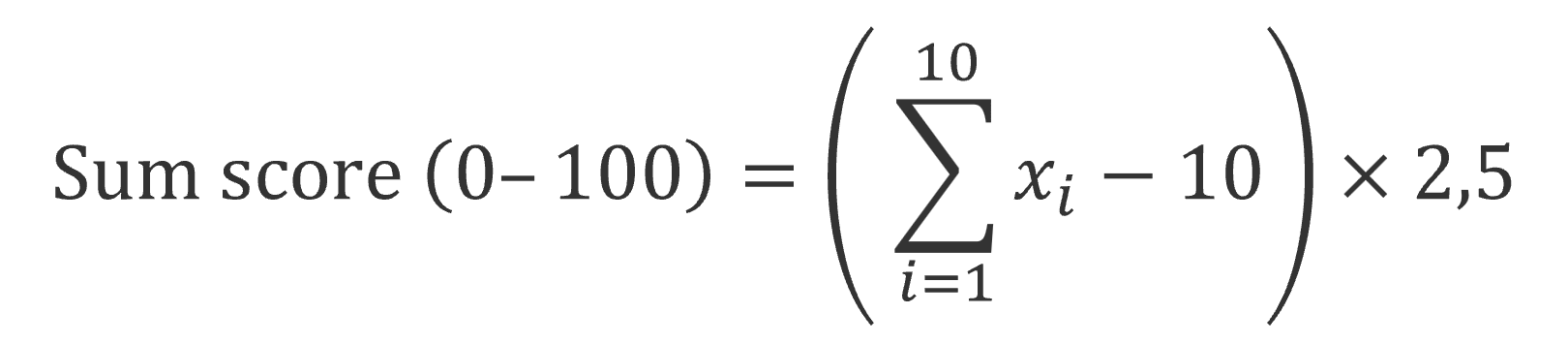
The scores for all 10 statements are added up (raw sum score 10-50). 10 is subtracted from the raw sum score (0–40 points remaining). Then, the remaining score is multiplied by 2.5. The result is a sum score between 0 and 100.
The formula implies that missing values (statements with no replies) are not allowed. The ESIS has been validated without allowing missing values.
Possible corrections for missing values have not been examined sufficiently. Preliminary results based on the data from the Sokra survey suggest that the imputation of one missing value with the mean score of the other statements would not affect the final result. However, the current recommendation is to only use fully filled out questionnaires for calculating the ESIS sum score.
More information about the validation of the Experiences of Social Inclusion Scale (ESIS) can be found earlier on this webpage and in the following publication:
Development and Psychometric Evaluation of the Experiences of Social Inclusion Scale.
Leemann, Lars, Martelin, Tuija, Koskinen, Seppo, Härkänen, Tommi & Isola, Anna-Maria (2022) . Journal of Human Development and Capabilities, 23:3, 400–424.
References
Syrjäytymisen hinta – case investoinnin kannattavuuslaskemasta.
Hilli, P., Ståhl, T., Merikukka, M., & Ristikari, T. (2017). Yhteiskuntapolitiikka 82 (6), 663–675.
Mitä osallisuus on? Osallisuuden viitekehystä rakentamassa. Isola, A.-M., Kaartinen, H., Leemann, L., Lääperi, R., Schneider, T., Valtari, S., & Keto-Tokoi, A. (2017). Discussion Paper 2017/33. Helsinki: Finnish Institute for Health and Welfare.
Gendered experiences of poverty and recognition in the Finnish welfare state. Isola, A-M., Siukola, R., & Kukkonen, M. (2019). NORA – Nordic Journal of Feminist and Gender Research 27 (3), 152–165.
On Social and Psychological Consequences of Prolonged Poverty – A Longitudinal Narrative Study From Finland. Isola, A-M., Virrankari, L., & Hiilamo, H. (2021). Journal of Social and Political Psychology 9 (2), 654–670.
Työelämän ulkopuolella olevien osallisuus ja hyvinvointi: Kyselytutkimuksen tuloksia. Leemann, L., Isola, A.-M., Kukkonen, M., Puromäki, H., Valtari, S., & Keto-Tokoi, A. (2018). Discussion Paper 2018/17. Helsinki: Finnish Institute for Health and Welfare.
Development and Psychometric Evaluation of the Experiences of Social Inclusion Scale. Leemann, L., Martelin, T., Koskinen, S., Härkänen, T., & Isola, A.-M. (2022). Journal of Human Development and Capabilities, 23:3, 400–424
Osallisuuden kokemuksen vahvistuminen ESR-hankkeissa: tulokset, mekanismit ja kontekstit. Nousiainen, M. (2025). Sosiaalilääketieteellinen Aikakauslehti, 62(2), 322–336.
Realistic evaluation of social inclusion. Nousiainen, M. & Leemann, L. (2024). Evaluation 30(2)
Hyvä elämä – turvallinen arki. Valtionevoston periaatepäätös sisäisen turvallisuuden strategiasta 5.10.2017. Ministry of the Interior (2017). Ministry of the Interior publication 15/2017. Helsinki: Ministry of the Interior.
Read more
Coordination for Equal Inclusion
Contact information
Lars Leemann (the primary contact person)
Researcher
tel. +358 (0)29 524 7509
[email protected]
Marko Nousiainen
Senior Researcher
tel. +358 (0)29 524 7225
[email protected]
Anna-Maria Isola
Research Director
tel. +358 (029) 524 7334
[email protected]