Quality report: Aggregate statistics on social services
Data description
Description of statistic
The aggregate statistics on social services are statistics published annually by the Finnish Institute for Health and Welfare (THL) on social services paid for by wellbeing services counties, the City of Helsinki and the Åland Islands, i.e. services that the wellbeing services county has either produced or purchased for its residents from other public organisations or private service providers. The statistics are published once a year, and the latest statistics cover the calendar year preceding the publication. The statistics have previously been called the Statistics on the activities of social services.
The statistics describe the number of clients in services provided under the Social Welfare Act and special acts. The statistics consist of four parts:
- Services for families with children and child welfare (home service, family work, parenting and family counselling, mother and child homes, number of foster families)
- Services for persons with disabilities
- Support for informal care, services supporting mobility and family care for older people
- Services for substance abusers
THL has been collecting the data since operational year 2015. Before that, the data were collected by Statistics Finland. The collection of data is based on the Act on the National Institute for Health and Welfare (668/2008). The data is used in contexts such as the indicator for the cost-effectiveness of organising social welfare and health care services (KUVA) and in THL’s Healthcare and Social Services Evaluation unit.
Relevance
The statistics contain data on the number of social welfare clients in social services that are not covered by other THL data collections. The purpose of the statistics is to produce extensive data on the key figures of different types of social services and comparable data on services in different counties.
The data are mainly collected from the wellbeing services counties as numerical data by municipality. They cannot be considered as reliable as data collections based on information from registers containing personal data.
Data content of the statistics
The statistical population consists of social welfare clients who have received social services within the statistical scope. The statistics contain extensively aggregated summary level data on various client numbers, appointment numbers and days spent in shelters.
Statistical process
Source data
The data in the statistics is based on the aggregated summary level data submitted by the regions each year, which the regions extract from their information systems in accordance with THL’s guidelines. The instructions for data collection are available on the website of the statistics.
Data collection
The data is collected from the wellbeing services counties each statistical year in January–February. The wellbeing services counties use the statistical searches carried out by client and patient information system suppliers, the results of which the wellbeing services counties enter on THL’s online form.
The data is collected only at the summary level – in other words, no unique information on clients, such as a personal identity code, is transferred to THL in the submission of data.
Data validation
THL strives to check and correct the data as extensively as possible. The objective is to identify missing and clearly erroneous values, such as abnormal or illogical data. Data validation is performed with programmed automatic checks that detect incorrect and abnormal values. The checks can concern issues such as incorrect number of clients or inconsistencies between different years.
Processing of the data
THL has developed automatic measures for correcting and updating the materials and electronic reports that can be used to identify errors in more detail. The regions’ responses are compared with those of the last three years. If a response differs substantially from the responses of previous years, THL will separately ask the region to check the responses it has submitted and, if necessary, correct the data.
Data revision
Data from previous statistical years is updated retroactively if necessary in connection with the next statistical publication. The impact of retrospective corrections on the figures has mainly appeared minor.
Quality assessment of the statistics
Accuracy and reliability
The accuracy of the data is affected by the quality of the data provided by the reporting bodies. A reporting body may fail to submit data or submit data that is incomplete or incorrect. For example, reporting bodies may misunderstand the content of the data that is meant to be collected, make tabulation errors or provide the nearest available data that does not meet the more specific definitions of the statistics.
THL checks the data and, if necessary, requests clarifications or corrections from the reporting bodies. Clarification is typically requested if the figures in the statistics differ significantly from the corresponding data of previous years. Deviations can be caused by several reasons, such as genuine changes in operations, but it is often the case that deviations are explained by changes in data management and data collection processes. For example, data collection practices may have been changed, information systems may have been updated or changed, or client relationships that have ended may have been closed or removed as a result of data maintenance.
Timeliness and punctuality
The data is collected at the end of the statistical year in January-February, and the aim is to publish the data no later than June. The publication of the data is slowed down by missing data and necessary corrections.
Coherence and comparability
As a rule, the data in the statistics are comparable between different periods and regions, but changes in data collection processes and regional differences may affect comparability. In principle, data from different wellbeing services counties are comparable because the instructions have been the same for all regions. In practice, however, comparability is limited due to regional differences, such as regions’ differing data extraction practices and applying differing methods to decision-making and outcome data. These differences may lead to lower comparability between regions, especially when the data is based on decision-making data or outcome data.
In addition, service systems have developed differently in different regions. When interpreting the indicators, it should be taken into account that a service with the same content can be provided by other social welfare and health care services as well. For example, some regions provide substance abuse services as a health care service, in which case the data on those operations is not included in these statistics. Services such as child guidance and family counselling can also be provided as part of health care services, in which case the inclusion of said services in these statistics varies.
Previously, more types of data were requested to be itemised by type of producer (provided internally, purchased from a public body, purchased from elsewhere, produced for others). In addition, until 2014, services purchased from municipalities, joint municipal authorities or the state were collected separately, but after 2015, services purchased from public entities are a combined category. Since statistical year 2023, the responsibility for data collection was transferred from municipalities to wellbeing services counties. The data for 2023 were provided by wellbeing services counties.
The data content in accordance with the data collection carried out by Statistics Finland until 2014 is described in the publication of the Association of Finnish Cities and Municipalities on the classification of financial and operational statistics for municipalities and joint municipal authorities.
The data content of the statistics is updated as necessary. Changes will be made to the statistics in the next few years, as data from the new social welfare monitoring register becomes gradually available for reporting.
The statistics have previously also included children who participated in early childhood education and care in 2015–2020, but this data is nowadays collected with the Varda system. In addition, clients who received home service in 2015–2019 were recorded in the statistics, but that data is now being collected with Avohilmo data collection. In 2015–2020, Statistics Finland was responsible for collecting financial data, but that responsibility was transferred to the State Treasury from 2022 onwards.
Coherence and comparability – Services for families with children and child welfare services
Special issues concerning the 2025 statistics
The figures for intensified family care, child welfare home services, home services for families with children and family work by the City of Helsinki were reported as client numbers instead of the number of families.
The Wellbeing Services County of East Uusimaa was unable to provide data on intensive child protection work, child welfare home services, family work in services for families with children or home services for services with families with children for statistical year 2025. The data on these questions have been imputed to all municipalities in the region with data from 2024.
In the North Ostrobothnia Wellbeing Services County, changes in the client information system prevented the production of data for the entire statistical year. That is why the data on home services for families with children was produced from 1 April to 31 December 2025. According to an estimate by the region, the majority of service clients are long-term, which is why the majority of clients included in the period of 1 January to 31 March 2025 can be estimated to be included in the reported figures.
The Wellbeing Services County of Vantaa and Kerava reported that, due to changes in their information system, it was no longer possible to separate child welfare home services from home services for families with children. For this reason, the number of clients in child welfare home services is included in the number of clients in home services for families with children. In addition, the region reported that the increase in the number of adult clients in child guidance and family counselling was explained by a change in recording practices, which resulted in the parent being recorded as a client more frequently than before.
Due to a change in the client information system implemented in the Wellbeing Services County of Southwest Finland, there may be overlaps in the number of clients in intensified family work, family work and mother and child homes. The number of families could not be produced reliably because family data has not been recorded in the system in all cases. The data are compiled from the statistics for the beginning and the end of the year, and the presented figures are estimates that take into account possible overlaps in client relationships.
Temporal comparability: development of data collection
As a result of the amendment to the Social Welfare Act of 2015 (1301/2004), the amount of preventive and targeted social services for families with children was increased in municipalities. To monitor this change, data collection was extended with new indicators in 2014.
This change also involved discontinuing data collection on the number of families with children who received home care assistance during the year (Sotkanet indicators 2037 and 2911) and separately starting to collect data on home service provided under the Social Welfare Act and the Child Welfare Act. In retrospect, it can be stated that the previous indicator corresponds fairly well to the data collected nowadays under ‘Families in home services for families with children during the year (Social Welfare Act, section 19)’, as can be seen from Figure 1.
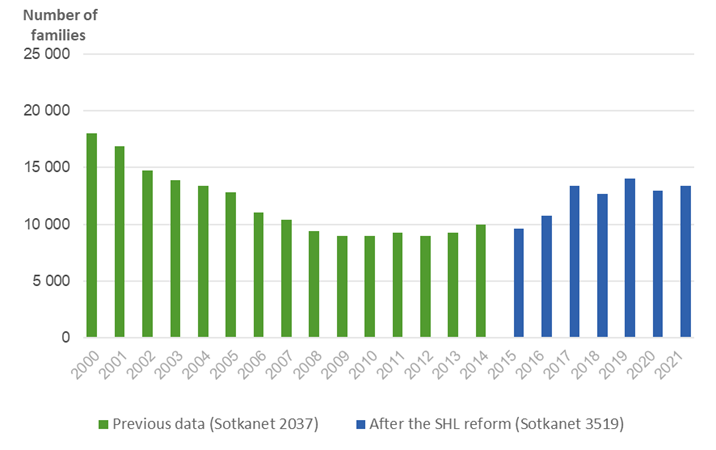
Figure 1. Families in home and child care services. The time series was generated by combining data collected until 2014 and data collected after 2014.
The transfer of data collection from Statistics Finland to THL was also concurrent. In this context, several types of data on child welfare care days were discontinued because the corresponding data were available in the Register of Child Welfare. However, data on the type of placement provider is not available from the Register of Child Welfare, as illustrated by Figure 2 on child welfare institutions.
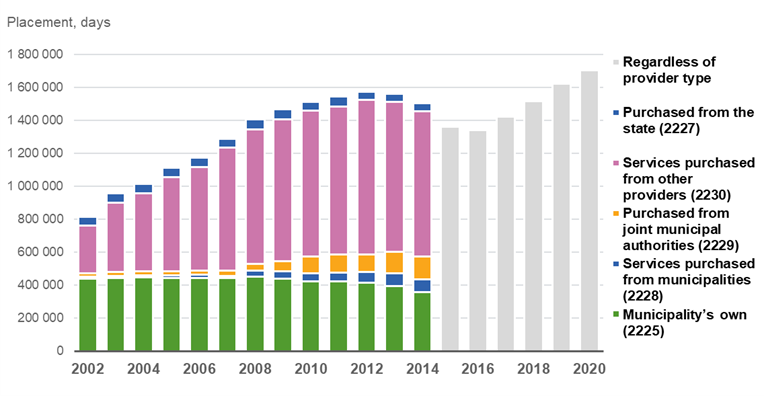
Figure 2. Placement days in child welfare institutions by producer type. The time series was generated by combining data collected until 2014 and similar data from the Register of Child Welfare since 2015
Data on child guidance and family counselling and mother and child homes was also reported by producer type until 2014.
The terms used in data collection have been harmonised to correspond with the terminology of the social welfare client data model since operating year 2021. Indicator names were harmonised with the concepts used in data collection during 2022.
The data on the number of families providing assigned family care in child welfare services differs significantly as of 2023. One family may offer family care to several children, and these children may have several so-called placing wellbeing services counties. In these cases, the same family appears several times in the statistics covering the whole country due to several regions reporting the same family. However, there are significantly fewer overlaps as of 2023, which is when the data started to be reported on the wellbeing services county level. The change is so significant that the Sotkanet service created separate indicators for the municipal data (3515, 3510) and the data provided by wellbeing services counties (6416, 6417).
Coherence and comparability – Services for persons with disabilities
Special issues concerning the 2025 statistics
In services supporting mobility in the Wellbeing Services County of Central Uusimaa, the age distribution of clients was based on the national average because the county was unable to produce data by age group.
The data on services supporting the mobility of persons with severe disabilities in the Wellbeing Services County of Ostrobothnia have been imputed with the data from 2024 because the county was unable to produce data for statistical year 2025.
According to the Wellbeing Services County of North Karelia, the data on clients in activities supporting employment in 2023–2024 also included supported work and job coaching granted under the Act on Special Care for Persons with Intellectual Disabilities. Since 2025, the data collection has been specified so that the reported figures only concern the services referred to in section 27 of the Social Welfare Act.
The Wellbeing Services County of Päijät-Häme corrected the data for 2023 and 2024 concerning the number of clients in activities supporting the employment of persons with disabilities on 31 December and the number of clients in daytime activities for persons with disabilities on 31 December.
In the Wellbeing Services County of Vantaa Kerava, it has not been possible to distinguish between Vantaa and Kerava in the number of clients of services that support employment and work and daytime activities. For this reason, all client numbers have been reported in the figures for Vantaa.
Temporal comparability: development of data collection
The data collection on services for persons with disabilities and the definitions of indicators have been revised as of statistical year 2025 to correspond to the new Disability Services Act (675/2023) that entered into force on 1 January 2025 and the updated guidelines for aggregate statistics. The aim of these changes has been to clarify the content of the indicators and to harmonise them to match the current service structure.
The content and scope of the indicators have mainly remained unchanged. For each indicator, all clients are reported together, regardless of whether the service has been granted based on the old or new legislation, and each client is counted only once during the statistical year. This improves the internal coherence and comparability of the data between wellbeing services counties.
The most significant change in terms of content concerns sheltered housing for persons with disabilities. Due to the legislative amendment, the data collection on sheltered housing was voluntary for statistical year 2025. From 2025 onwards, the indicators for sheltered housing also cover housing support under the new Disability Services Act, which includes individual assistance and support for the client’s living either in their own home or in a communal form of housing.
During the transition period of 2025–2027, sheltered housing and housing support make up a single service package, and all clients covered by these services will be reported as a single number of clients. The reporting is carried out regardless of whether the service was granted based on the old Act on Disability Services and Assistance (380/1987) or the new Disability Services Act (675/2023), and each client is counted only once during the year.
As a result of this change, the numbers of clients in sheltered housing are not fully comparable with previous years.
For other services for persons with disabilities, comparability is primarily affected by regional differences in the way services are organised and the setup of service packages. For these reasons, the levels of individual indicators describe the scope of services but do not, as such, reflect the entirety of services for persons with disabilities in the wellbeing services county.
As of 2021, the definitions used in data collection were harmonised with the concepts of the social welfare client data model. This also included a step towards utilising the service task classification in the description of services.
Previously, the data content had been determined based on the law under which the service was granted. However, information systems have challenges in retrieving data in a uniform manner. Some municipalities have experienced difficulties in distinguishing clients of services for persons with intellectual disabilities (or excluding them especially with regard to sheltered housing). In addition, persons with disabilities have been granted the services referred to in this data collection in accordance with the Social Welfare Act, and there are municipality-specific differences in the reporting of these services as well.
Services arranged with a service voucher have also been included in the data since 2019. This change had the greatest impact on the data for Helsinki. Some municipalities had included the number of clients of services produced with a service voucher in the data already before the change.
After the Family Care Act (263/2015) was enacted, the instructions on family care in services for persons with disabilities were specified to apply to care provided under the Family Care Act, which can be short-term or long-term and part-time or round-the-clock. Since 2023, family care days and the number of family care homes have been collected for each wellbeing services county. The change is so significant that the Sotkanet service created separate indicators for the municipal data (3469) and the data provided by wellbeing services counties (6418).
Coherence and comparability –Support for informal care, services supporting mobility and family care for older people
Special issues concerning the 2025 statistics
The number of care days of family care for older people in the City of Helsinki, 285 care days, also includes informal care days lasting more than six hours since it has not been possible to separate them from the data. The number of family care homes for older people should match the situation on 31 December 2025, but Helsinki has not been able to produce current data. The number used in these statistics – seven family care homes – is based on the situation on 27 January 2026.
The Wellbeing Services County of Ostrobothnia was unable to produce data on the number of informal carers. For this reason, the number of informal care recipients has been used as the number of informal carers. The age distribution of informal carers was based on the national averages for 2023 and 2024.
The Wellbeing Services County of Vantaa Kerava has corrected the data of both municipalities concerning the number of informal carers and the number of informal carers aged 65 or over for statistical year 2024.
Temporal comparability: development of data collection
Some of the wellbeing services counties are unable to provide the number of informal carers, so it seems in the indicator analysis that a municipality has informal care recipients but no informal carers. As the number of informal care recipients and informal carers mainly matches one another (usually a difference of 0–3%), THL supplements the number of informal carers with the number of informal care recipients if the figure is missing. The number of informal carers has also been adjusted to correspond to the number of informal care recipients if the difference between the number of informal carers and care recipients has been +/- 20%.
A similar correction cannot be made for informal carers aged over 65. For this reason, the number of informal carers and informal carers aged over 65 should only be examined in areas where the number of carers aged over 65 has also been reported. In 2021, 59% of informal carers were over 65 years old in the municipalities that were able to report the data.
Home service data were collected as part of the data collection in 2015–2019.
Data on support services were collected until 2022. The definition of data and the retrieval of data for statistical use were not well-established, which meant that changes to data definition, new information systems or changes to employees could entail major changes. For this reason, the data on support services should be approached with some reservations. For example, as of 2021, reporting bodies were asked to also include service voucher data in their data on support services, unlike in previous years.
Until 2019, reporting bodies were asked to provide data on home services. The collection of this data was discontinued because data that was similar to some extent was available in the Avohilmo data collection. Home service visits in the database report.
Coherence and comparability – Services for substance abusers
The data collection on services for substance abusers was reformed entirely for statistical year 2024 to comply with current legislation and service practices. In the data collection for statistical year 2024, the new questions were voluntary for the respondents, and the respondents were asked to give feedback on the functionality and practical feasibility of the questions. The data on services for substance abusers was not published in 2025; instead, data for statistical years 2024 and 2025 will be published together in 2026
Changes in data collection:
Clients in services for substance abusers at A-Clinics during the year
→ Since 2024: Outpatient substance abuse and addiction social welfare services for adults, number of clients and visits
Clients in services for substance abusers at youth stations during the year
→ Since 2024: Outpatient substance abuse and addiction social welfare services for young people, number of clients and visits
Clients in services for substance abusers in emergency shelters during the year
→ Data collection discontinued
Treatment days in emergency shelters, itemised by production method
→ Data collection discontinued
Clients in services for substance abusers at detoxification stations during the year
→ Data collection discontinued
Treatment days at detoxification stations, itemised by production method
→ Data collection discontinued
Clients in services for substance abusers in rehabilitation institutions during the year
→ Data collection discontinued
Treatment days in rehabilitation institutions, itemised by production method
→ Data collection discontinued
Residents in service and support housing for people with substance abuse problems on 31 December
→ Data collection discontinued
Residents in service and support housing for people with mental health problems on 31 December
→ Data collection discontinued
A question was added to the data collection:
→ Since 2024: Day centres for substance abusers, number of clients and visits
In addition, information on the clients of housing services for substance abusers and treatment days was requested by wellbeing services county and no longer by the municipality of residence.
A new question was added to the data collection for 2025, and relaying that data was voluntary for the regions:
→ Temporary accommodation for substance abusers (formerly drop-in shelter), number of clients and visits.
In 2026, wellbeing services counties faced significant challenges in providing data on the previous year. A total of 17 wellbeing services counties provided additional information in connection with the data collection where they described problems and challenges related to the data they submitted.
The Wellbeing Services County of South Karelia was unable to provide information on the outpatient substance abuse and addiction services for adults and young people or on the temporary accommodation of substance abusers for statistical year 2025.
The Wellbeing Services County of South Ostrobothnia was unable to itemise the data on outpatient substance abuse and addiction services for adults and that data for young people and reported all the figures as adult data instead. Temporary accommodation for substance abusers (formerly drop-in shelter) is not available in the area. The number of decisions on temporary accommodation is indicated here.
Under “Outpatient substance abuse and addiction social welfare for adults”, the South Savo Wellbeing Services County reported the number of clients aged over 18. The number of clients includes the social counselling, social work and social rehabilitation provided in the service task of special services for substance abuse and addiction work. No statistics are compiled on the number of visits in the area.
The number of clients in sheltered housing in the region includes the clients of supported housing, communal housing and 24-hour sheltered housing provided in the service task of special services for substance abuse and addiction work. The number of days clients spent in sheltered housing is indicative.
South Savo was unable to provide information on day centres intended for substance abusers. With regard to temporary housing, the region reported that 13 clients had received services for working-age people, but the region was unable to itemise the percentage of clients abusing substances. For this reason, the region omitted the response to this question.
The Wellbeing Services County of East Uusimaa was unable to provide information on substance abuse and addiction services. The data for the region’s statistical year 2024 have been imputed based on the data of statistical year 2025.
To questions concerning sheltered housing for substance abuse rehabilitees and substance abusers, the Kanta-Häme Wellbeing Services County only reported the clients who had received services produced by the county and the days they spent in sheltered housing.
The Wellbeing Services County of Central Ostrobothnia does not have separate arrangements for outpatient substance abuse and addiction services for young people. All clients aged over 18 were included in the data on outpatient substance abuse and addiction work for adults.
The Wellbeing Services County of Central Finland was unable to extract information from its information systems on outpatient social welfare services for substance abuse and addiction.
The Wellbeing Services County of Lapland was unable to provide data on services for substance abusers.
The Western Uusimaa Wellbeing Services County reported that there are no figures available on the number of clients in day centres and on the number of visits to outpatient substance abuse and addiction services for adults, as the wellbeing services county procures services as outsourced services and has therefore insufficient visibility to the data. Outpatient substance abuse and addiction services for young people have not been organised in the region. The number of clients in sheltered housing includes the clients in services produced by the county and as outsourced services.
The Wellbeing Services County of Pirkanmaa only reported adult clients to the number of clients in outpatient substance abuse and addiction services. The data were extracted from the number of clients in social rehabilitation for substance abusers. In addition, data on sheltered housing for substance abuse rehabilitees and substance abusers purchased as outsourced services could not be provided.
The majority of outpatient substance abuse and addiction services in the Wellbeing Services County of Ostrobothnia were organised in health care services. The reported figures include the clients of the care and rehabilitation unit at the Pixne clinic and the clients who have a service decision concerning social work or social guidance active in the service task of substance abuse and addiction services.
The region is unable to specify whether the service decision related to a client’s housing has been made based on substance abuse or mental health criteria, which is why the responses are based on estimates. Clients are mainly long-term residents in the county’s own housing service units. On this basis, the number of days spent in sheltered housing is calculated as the number of clients × 365 days.
In the Wellbeing Services County of North Karelia, the practices for recording decisions on the social guidance, social work and social rehabilitation for substance use are still being developed. In addition, data collection on visit numbers could not be carried out. The region only reported data to questions concerning sheltered housing for substance abuse rehabilitees and substance abusers.
The Wellbeing Services County of North Ostrobothnia only provided data on visits to day centres intended for substance abusers and the number of clients and visits to temporary accommodation for substance abusers (formerly drop-in shelter). The region reported that it is unable to provide other data on substance abuse services reliably since the data is located in patient information systems where it is not possible to reliably distinguish between substance abuse service clients and mental health clients.
The Wellbeing Services County of North Savo was unable to provide data on outpatient substance abuse and addiction work in social welfare.
In its response on day centres intended for substance abusers, the Wellbeing Services County of Päijät-Häme specified that it is an anonymous service. For this reason, it is almost impossible to estimate the number of clients since the same client can use the service either occasionally or daily.
In the Wellbeing Services County of Vantaa and Kerava, it is not possible to separately itemise the outpatient substance abuse and addiction services for young people. The increase in the number of clients in sheltered housing is partly due to actual growth and partly due to the previous deviating reporting method. For day centres, only the number of clients is monitored since the service is anonymous.
The Wellbeing Services County of Southwest Finland underwent a change in the client information system in the middle of 2025, which caused challenges in extracting data. For this reason, it was not possible to provide data on visits to day centres and the days spent in temporary accommodation for substance abusers.
Institutional mandate
The production of the statistic is based on the Act on the National Institute for Health and Welfare
(688/2008) and the Statistics Act (280/2004). One of the official tasks of the Finnish Institute for Health and Welfare is to produce statistical data on the health and welfare of the population, the factors affecting them, and the use and functioning of healthcare and social welfare services to support decision-making, development and research. THL’s statistical production practices are guided by the instructions, recommendations and regulations of Eurostat and the Official Statistics of Finland as well as the principles of statistical ethics.
Data sharing and publishing
The Finnish Institute for Health and Welfare publishes the data in advance at the time indicated in the statistics publication calendar. The data is made public to all users at the same time. Instead of publishing a separate statistical report on the aggregate statistics on social services, results are reported extensively in various Sotkanet indicators and Kuva indicators.
Statistics publication calendar.
Confidentiality
As an authority, the Finnish Institute for Health and Welfare is tasked with reporting collected data regarding national health and welfare. The data used to draw up THL’s statistics is primarily confidential, and personal data may not be published. The protection of processed data is based on the Act on the National Institute for Health and Welfare (688/2008), the Statistics Act (280/2004), the Act on the Openness of Government Activities (621/1999), the EU General Data Protection Regulation (EU) 2016/679 and the Data Protection Act (1050/2018) as well as other regulations guiding the activities of the Institute.
Special issues concerning the 2025 statistics
In statistical year 2025, the ability of the wellbeing services counties to provide the extensive data required by the statistics continued to improve compared to the previous year and compared to the time before the establishment of the wellbeing services counties.
Special issues are addressed separately for each theme in section 4.3 Coherence and comparability.
Notes on the use of the statistics
Regional and thematic variation has always been typical of the data in the statistics on the activities of social services. The data describing an individual year of an individual indicator may be subject to excessive fluctuation, but they are still useful in the description of trends and magnitude.
How have the data on the entire country developed in the preceding years? If the development has been steady, it is likely that there have been fewer changes in the provision of services or in defining the data. However, please note that a stable national average may sometimes hide considerable opposite regional changes.
Are there significant regional differences between wellbeing services counties? It is characteristic of almost all social services that there are considerable differences in the commonness of the services: in the wellbeing services county with the largest number of clients, the number of clients is higher by one half than in the county with the lowest number of clients. Are there still bigger, multiple differences?
How have the data of the wellbeing services county or its municipalities developed in the past few years? In most cases where the changes have been very extensive, THL has requested that the data be checked. These checks are carried out to ensure that typing errors have not been made, for example, when the data have been entered or that the data for the county are not missing completely. If reliable data are not available, utilisation of the data from the previous year may have been agreed on with the wellbeing services county.