
Prevalence of ADHD diagnoses among children and young people in 2023
Prevalence of ADHD diagnoses continues to grow – gender differences are narrowing especially among the adolescent population.
The prevalence of attention-deficit hyperactivity disorder (ADHD) diagnoses among children and young people (7–17-year-olds) continues to grow. Based on the data in the Care Registers for Health Care of the Finnish Institute for Health and Welfare (THL), 36,611 boys and 15,939 girls (a total of 52,550 children and young people) who had used health care services in 2023 had an ADHD diagnosis. In 2020, the corresponding figure for boys was 20,385 and for girls 6,483 (a total of 26,868 children and young people). According to the data of the Social Insurance Institution of Finland (Kela), approximately 46,500 children and young people used ADHD medication in 2023.
Based on international studies, the prevalence of ADHD among children and young people meeting the diagnostic criteria is estimated to be approximately 5–8%. In Finland, the prevalence of ADHD diagnoses among primary school-aged boys was 11.3% in 2023. The corresponding figure for boys in the adolescent group was 9.5%. The prevalence of ADHD diagnoses among girls was 3.9% in the primary school-aged and 5.7% in the adolescent population. There has been a considerable increase in the diagnoses between 2015 and 2023. Based on the data in the Dispensed medicines reimbursable under the National Health Insurance scheme (formerly known as the Kela Prescription Register), the trend in ADHD medication use among children and young people closely mirrors the trend in diagnosis rates: In 2023, at least one ADHD medication purchase was recorded for 33,142 boys and 13,355 girls (a total of 46,497 children and young people). In 2020, the corresponding figure for boys was 20,862 and for girls 5,852 (a total of 26,714 children and young people).
The prevalence of ADHD diagnoses varied considerably between wellbeing services counties, ranging from 5.2% to 21.5% for boys and from 2.3% to 9.6% for girls. Relative to the population of the same age, diagnoses were most common in Eastern Finland. Similar differences were observed in the prevalence of the use of ADHD medication between wellbeing services counties.
The determination of the prevalence of ADHD diagnoses is based on data from THL's Care Registers for Health Care, i.e. Hilmo registers. The statistics take into account children and young people aged 7 to 17 who have visited primary health care (Avohilmo register, incl. school health care) or specialised health care (TerveysHilmo register) at least once during the calendar year under review. A case is a person for whom an ADHD diagnosis is found as a reason for visit or as a primary, secondary or long-term diagnosis.
Download the full Statistical report
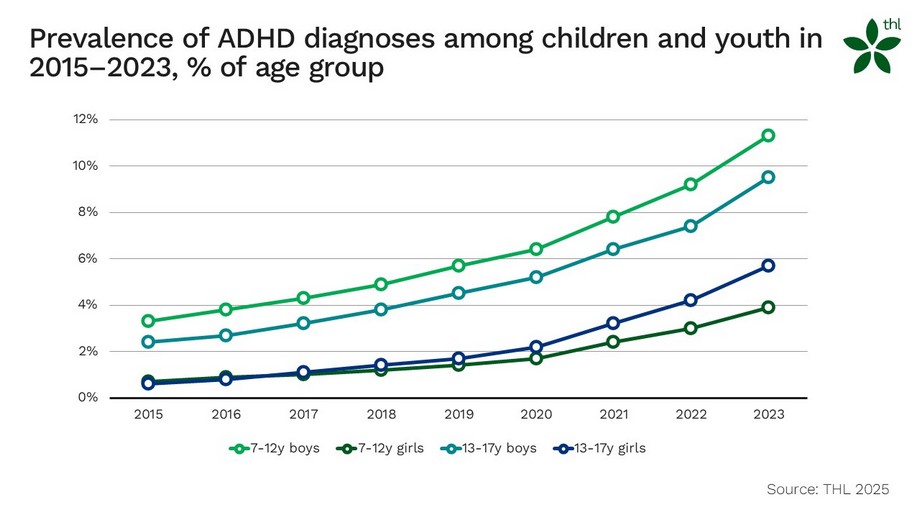
Annual prevalence of ADHD diagnoses among children (7–12 years) and young people (13–17 years) 2015–2023, % of age group
Tables
Background information
- Quality report
- Data description (Data resources catalogue)
- Care Register for Primary Health Care (Avohilmo)
- Care Register for Health Care (Hilmo)
Description of the statistics
The statistics on the prevalence of ADHD (attention-deficit hyperactivity disorder) diagnoses in children and young people are part of the health and well-being monitoring of children, adolescents and families included in the FinChildren entity of THL. The data of the statistics are based on individual-level care registers of primary health care (Avohilmo) and inpatient care in health care and hospitals, as well as outpatient care in specialised medical care (TerveysHilmo).
The statistics on the prevalence of ADHD diagnoses among children and young people take into account all persons whose entry in the care register included an ADHD diagnosis (Classification of Diseases ICD-10 codes F90 or F98.8). The ADHD diagnosis could be the reason for the visit or primary, secondary or long-term diagnosis. The examination is limited to children and young people aged 7–17. The data content of the statistics has been aggregated so that the prevalence of ADHD among children and young people is examined by gender and wellbeing services county in the following age groups: 7–12-year-olds and 13–17-year-olds. The statistics cover data on the prevalence of ADHD diagnoses among children and young people since 2015 (so-called annual prevalence) and illustrate the trend of ADHD diagnoses among children and adolescents in Finland by age and gender group. In addition, the prevalence of ADHD diagnoses is examined by wellbeing services county.
In these statistics, prevalence refers to persons for whom an ADHD diagnosis entry related to a visit to primary health care or specialised health care can be found in the Hilmo registers at least once in each calendar year under review (so-called annual prevalence). The annual prevalence figure does not distinguish between new cases (incidence) and cases confirmed in previous years. The prevalence expressed as a percentage has been calculated by proportioning the number of cases to the population of the same age and gender. The population rate in the last week of the calendar year is used for calculating the population estimate.
Data on the prevalence of ADHD diagnoses extracted from the Hilmo registers have been compared with Kela's register data on ADHD pharmacotherapy. The comparison data from Kela's Dispensed medicines reimbursable under the National Health Insurance scheme (formerly known as the Kela Prescription Register) were extracted separately with the same age, gender and area restrictions as the data from the Hilmo registers used in the statistics. Based on the comparison, these statistics provide a fairly reliable overall picture of the prevalence of ADHD diagnoses among children and young people in Finland. However, a more accurate overall picture could be obtained by combining individual-level data from THL's and Kela's registers.
The statistics and the Statistical report are updated and published annually.
Source
Lasten ja nuorten ADHD-diagnoosien yleisyys 2023
Förekomsten av ADHD-diagnoser hos barn och unga 2023
Prevalence of ADHD diagnoses among children and young people in 2023
Statistical report 14/2025, 28 March 2025
Additional information:
Miia Paavilainen
tel. 029 524 7675
Terhi Aalto-Setälä
tel. 029 524 7437
email: [email protected]


